
Cytrix Security offers mobile app security testing for businesses in focusing on data, access and application risks.
Review mobile app security weaknesses
Discuss an application security assessment
Discuss mobile application security
Plan testing for risk reduction
Certifications held
Report turnaround
Working days per test
OWASP Testing Guide
Our mobile application security testing process follows four stages, from defining the assessment scope to identifying vulnerabilities, validating security risks, and providing remediation guidance.
We define the testing objectives, application platforms, user roles, and access requirements. The scope and testing boundaries are agreed upon before the assessment begins.
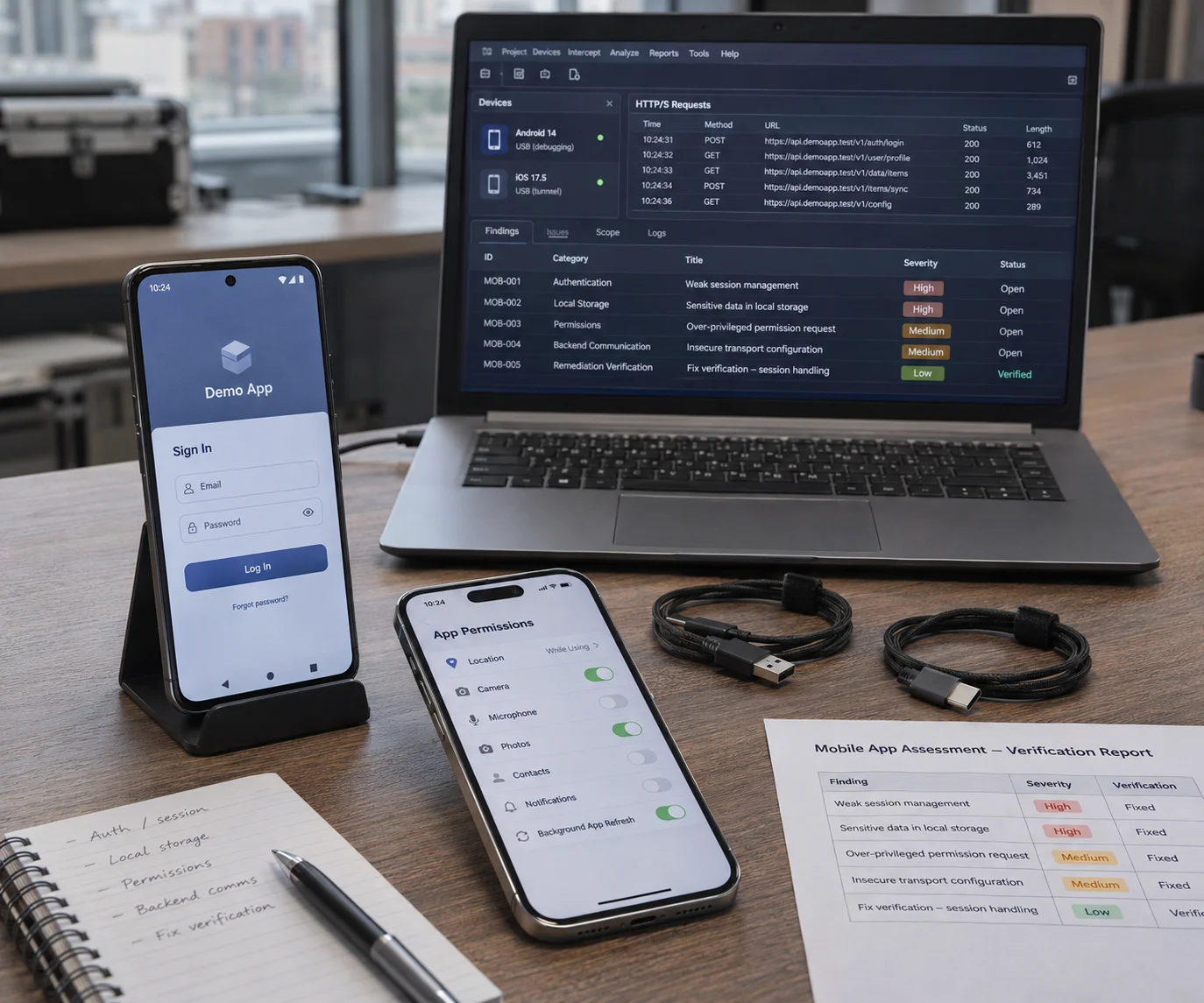
We examine Android and iOS application security controls, including authentication, data storage, session management, permissions, and API communication, based on the agreed scope.
Identified security weaknesses are reviewed to understand their potential impact on user accounts, sensitive data, and application functionality. Findings are evaluated within the authorized testing scope.
Assessment findings are organized by security risk, with recommendations to help developers address identified weaknesses. Remediation Validation & Retesting is available to verify implemented fixes.
Coverage can include authentication, authorization and security controls; exact checks depend on your agreed assessment scope.
Review how access decisions and sessions may expose accounts to unintended actions or permissions.
Consider how sensitive data is stored, protected and accessed on a mobile device.
Examine network communication between the app and connected services for potential exposure.
Review whether connected APIs enforce access rules for users, records and actions.
Consider device permissions and security configurations that affect how an app behaves.
Discuss vulnerability assessment and threat detection needs for distributed application builds.
5 to 7 Days
Mobile app security requires more than automated scanning. Cytrix Security helps businesses assess application risks, identify security weaknesses, and understand where improvements are needed.
Assess security risks affecting Android and iOS applications, including authentication, data storage, permissions, and communication with backend services.
Identify potential vulnerabilities in your mobile application and understand how they could affect sensitive data, user accounts, and business operations.
Address identified security weaknesses with remediation guidance. Cytrix Security also offers Remediation Validation & Retesting to verify security fixes.
Mobile application security testing begins with an agreed scope and authorization. Cytrix Security discusses testing permissions, sensitive data handling, and potential disruption before the assessment.
Assess authentication, authorization, and data exposure risks in the APIs connecting your mobile applications to backend systems and services.
Identify, prioritize, and manage security vulnerabilities across your IT infrastructure and connected systems to support your mobile application security efforts.
Examine your mobile application’s source code for insecure coding practices, authentication weaknesses, and potential vulnerabilities that may expose sensitive data.
Mobile application security testing is the process of identifying security vulnerabilities in Android and iOS applications. It evaluates authentication, access controls, sensitive data storage, and communication with backend systems. Cytrix Security helps businesses assess potential security risks and identify areas requiring improvement.
A mobile app security assessment examines potential vulnerabilities in authentication, authorization, data storage, encryption, and API communications. Depending on the agreed scope, testing may also cover insecure configurations, session management, and platform-specific security weaknesses.
Android and iOS security testing address many of the same risks but account for differences in their operating systems and security controls. Android assessments may examine application permissions, exported components, and local data storage. iOS assessments may focus on Keychain usage, application sandboxing, and platform-specific security configurations. The exact testing scope depends on the application.
Mobile applications should be assessed regularly, particularly after major updates, new feature releases, or changes to authentication and API integrations. Organizations should also consider testing before production launches and following significant security incidents. Testing frequency depends on application complexity, data sensitivity, and business risk.
Mobile app security testing evaluates vulnerabilities within Android and iOS applications, including local storage, authentication, permissions, and device interactions. API security testing focuses on backend interfaces, authorization controls, and data exchanged between systems. Combining both assessments can provide broader visibility into application security risks.
The cost of mobile application security testing depends on application complexity, the number of platforms, testing requirements, and assessment scope. Applications with multiple user roles, complex features, or extensive API integrations may require additional testing.
Contact Cytrix Security at info@cytrixsecurity.com to discuss your application and request pricing information.